By Grace Arnold & Gabrielle Bunton
Gabby and I met last year at the Danish School of Media and Journalism (DMJX) while on our exchange programs last year. As some of the only students from the United States navigating our new lives as students in Denmark, we instantly connected over our shared life experiences in the United States. We also connected over our love of blogging and writing.
Gabby inspires me in so many ways: she is a brilliant writer and journalist, a dedicated advocate for the black community, and not to mention she’s writing 2 books! Besides that, she is a kind and passionate individual, which is why I am SO excited to collaborate between our blogs.
In preparation for this post, we talked a lot about our experiences mentally, emotionally, socially, and professionally post-grad. Here are our insights:
1. Getting your first job
GABBY: The time has finally come … the four years are done and you have finally graduated. All the knowledge and experiences have prepared you to start your career with your first job. But where do you start? What do you look for? How do you even get started?
Getting your first job can be a rollercoaster, so here are some things to expect. First, analyze the job market. That means seeing how your degree lines up with job openings in the market. Despite what anyone says, everyone is always hiring if you look in the right places.
For example, I graduated in August 2022 with a degree in journalism. I got my career job in September 2022 from posting on social media after graduating. A long-time family friend told me about a job opportunity on my Facebook post and now I’m here.
Before that, I had begun researching job openings months ahead to see what it’s like for me. I had multiple groups involved in my field that posted job openings and I lived faithfully by LinkedIn. Despite everyone telling me that ‘journalism is dead’ and ‘it was going to be hard’.
The job market is not the complex scheme that everyone tries to make it out to be. It’s all about using your resources. This leads me to another point …
Secondly, use your network. College is more about making connections than trying to make memories. The biggest thing I hear from people who doubt college is that it’s a waste of money. But can you put a price on meeting people in your future field and having opportunities to expand your craft?
Throughout your four years, you should always be meeting and connecting with people that could help your career. College is something where you get out what you put in. For example, every organization I was in was official, had credibility, success stories, professionals who mentored me, and multiple opportunities to expand myself.
I always had people around me who made something of themselves, wanted to elevate, and wanted to make something of themselves. Your network is your net worth. Your network can make the job process a lot easier.
Third, prepare yourself for rejection. Rejection is hard in any situation, but I know that it can be very disheartening when you are really trying to go after someone. One door closes and another opens. I always have the mentality that rejection is setting me up for a bigger blessing. That opportunity may not be for you. That’s okay. Feel every emotion unapologetically.
But don’t keep yourself in a sunken place, because you are bright. Everyone has potential.
“It’s time for you to move, realizing that the thing you are seeking is also seeking you.”
– Iyanla Vanzant
I always think about this quote when things don’t go my way or when I start to doubt myself. Rejection comes with life. What is meant for you will come to you. Keep your head up!
Next, have a job until you get that career job. The process can be grueling and tedious. And in this economy we can’t wait around with no income coming in. Speaking from experience, you get pushed head-first into adulthood after college. If you’re not already, you have to pay bills, get groceries, make sure you have a roof over your head, etc. The freedom and structure of the college are a safety net for many all of us. For instance, you can live on campus, get food, have a job, and more.
I think having your own motion going outside of the process will help set you up. You can not have enough money coming in. Plus, having a job can keep you occupied. You may not enjoy what you’re doing but it’s better to just have that security.
Lastly, NEVER listen to people who have never been in your shoes or predicament. To me, this is one of the biggest pieces of advice that I can offer someone coming out of college. There are gonna be so many opinions from all over. But the loudest vices will be from people who have never been where you want to go, have not done anything with their life, or are simply haters.
You can tell the difference between people who are wise compared to those who are telling you something that is no good. There are people out there who will try to steer you in the wrong direction. It’s better to rely on the network of professionals you gathered in college, family, and friends.
Keep that circle tight. Stay on course. Distractions always get come when you are making it big. It will usually come in the form of people. Don’t let anybody make you pivot.
All in all, the journey of life after college is a difficult one, but make the best of it. You have spent four years of your life studying something you are passionate about. It can be scary to step out and find your first job but go for it. Good luck to everyone!
2. Pressure to accomplish things while you’re young
GABBY: Everyone always says that your 20s is the time for your mistakes, but when you make a mistake everyone says that you are too old to do that. Your 20s are one of the most important phases of your life (to me). It’s a phase in your life that will set up how the rest of your life will go.
While this is the time for mistakes this is the time for you to lay the foundation of your future. Typically, people are in college from 18 to around 22. Your earliest year of adulthood is centered around structure, education, and most importantly success.
While we are trying to pay bills, we are also studying to get passing grades to maintain scholarships. We are working jobs while trying to get internships. We are trying to maintain relationships while creating them with others who can help us.
We are being pushed to maintain this stability in our lives while trying to create a stable future. And our success relies heavily on that. My advice for young people in college is to be okay with failing. Be okay with winning.
Be okay with being sad. Be okay with being happy. This is the life you are creating. Don’t let what others do make you feel like you have to be on that level to succeed. Every journey is different. Embrace yours.
GRACE: The pressure to accomplish big things at a young age is all around us. I feel like every time I open up TikTok, people my age are increasingly stepping into entrepreneurship or going on expensive vacations. I think as a young person, there is pressure to accomplish a lot of things by 30 (Forbes 30 Under 30 immediately comes to mind). I constantly remind myself that my life and accomplishments will have value even as I exceed that age.
I will admit, I have also fallen into the mindset that I need to be successful by society’s standards, even at 21. After graduating college, however, I realize that it is more about the journey than the destination, and my focus is shifting to making small steps in the direction of the person I hope to be. I am learning it is possible to make a difference and still take it slow. The pressure to accomplish things at a young age can be overwhelming, but it is important to remember that everyone’s timeline is different. The reality is, there is no one-size-fits-all approach to success.
3. Making a Routine
GABBY: I think the biggest adjustment when graduating is the structure you lose. You have classes, assignments, or other obligations that you have to do on time or you face repercussions. In the beginning, I struggled with trying to do things when I didn’t have them planned out.
The development of my self-autonomy has been something that I am still figuring out. But I knew that having a schedule or routine was on the right path to my own success and having discipline. My biggest suggestion to everyone is to make a solid routine for yourself, such as making your bed, taking vitamins, going to work, etc.
Take it day by day. These things aren’t something that you can do overnight (unless you got it like that). Set small goals for yourself until you are ready for the larger goal. Most importantly, BE CONSISTENT. You won’t see real results unless you make that effort.
And also be prepared to have those setbacks. As I said it’s not something that comes overnight. You will have days where you forget or you may not be up for it. THAT’S OKAY. As long as you get back up and push forward that’s better than nothing. Make a routine and stick to it!
GRACE: I have to admit, I am a creature of habit. I love a good daily routine, and I think that is partially why I thrive in an academic environment. During my transition out of college, I continued to keep a pretty strict routine for myself when it comes to working, job searching, exercising, etc.
On a larger scale, the departure from the education system also means a departure from the “routine” of having the next steps clearly lined out for us. The promise of the next four years of high school or college felt safe. Now, I am coming to terms with the expansiveness of life before me. Setting short-term and long-term goals has helped with this, and made me realize how much power I have to shape the next steps of my life.
The best advice I received came from my sister. She told me I should take a day each week that is not part of my usual routine. These days became important for my wellbeing-they are days that are centered around having fun rather than taking steps to reach any kind of goal.
3. Finding something to do: Hobbies Post-grad
GABBY: What I miss from college is always having something to do. You could literally come out of classes and see events set up everywhere. Having those opportunities was a great way to escape the life of academia.
After graduation, the party girl I used to be rarely leaves the house now. It’s not that I’m unwilling, but it’s hard to find things that I think are fun. As I grow older, I am more interested in something long-lasting rather than chasing temporary pleasures like partying. It’s also important to break up that routine of just working and coming home.
I have recently gotten into the groove of dedicating my weekends to getting out of the house. It doesn’t matter if I’m walking to the park, going to the movies, working out, etc. It makes things better overall because I’m doing something where I have the choice to do it and I’m having fun. Don’t get me wrong, I love my job, but everyone needs a break.
And if you are anything like me, I am very strict with myself when it comes to my career. I always want to work hard and forget about everything else. I used to think that my reward would be to do things that I enjoy. The result of that came with so many instances where I didn’t get to experience life or that I never got the chance to simply relax. I now know that it’s okay to make yourself a priority. I always put out the best work when I felt my best.
Set aside time for yourself. You worked hard to get where you’re at..
“Caring for myself is not self-indulgence, it is an act of political warfare”
-Audre Lorde
GRACE: One of the biggest things I can recommend is finding a hobby that involves group activity. I consider myself a highly social person, and one of the things I miss the most about being in college is the opportunity to be involved with clubs that involve my interests.
One thing I have noticed about post-grad life is many of the hobbies I am drawn to are largely solo. I love to run, hike, or play piano, but I found myself craving a more tight-knit community of similar-minded people. I have devoted my time to volunteering and reaching out to friends from college and high school.
Another hobby I’ve rediscovered is reading for pleasure. In college, I read a lot for my classes, but I didn’t read just for fun. It’s been a great way to expand my perspective and learn new things. I think there is a misconception that hobbies have to be monetizable or productive in some way, but reading is a reminder that I can do things just for fun.
To be honest, finding that community of people with similar interests and hobbies continues to be an ongoing search, one that will be and flow during my life. I’m still not sure I have all the answers on how to find that perfect community, but in the meantime, I am going to continue doing what I enjoy and putting myself in spaces where others enjoy similar things.
5. Finding yourself
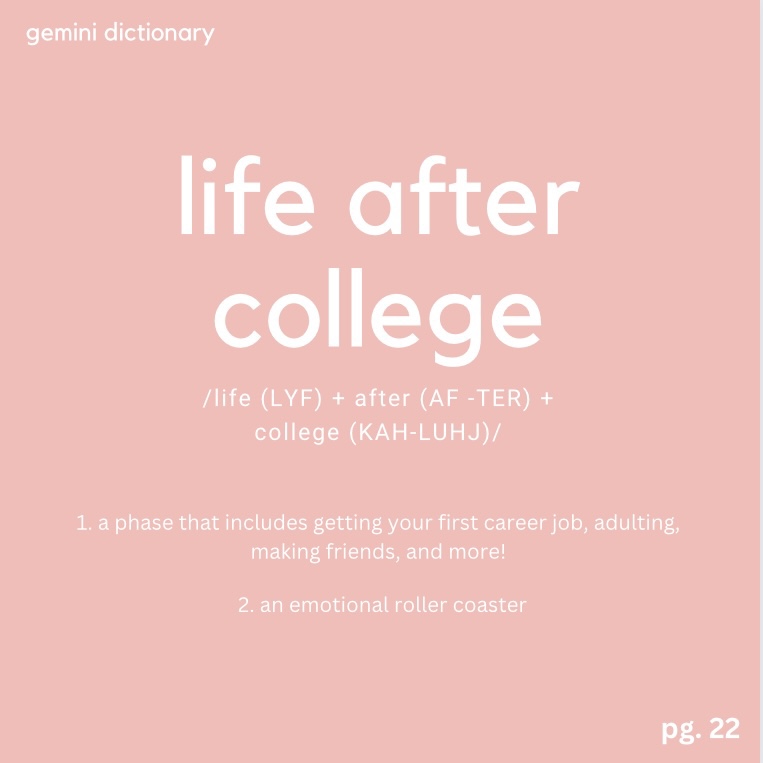
GABBY: Finding who you are is a never-ending journey. In the early stages of your life, you are being molded by your parents, friends, institutions, friends, etc. Now that you are more on your own, it can be pretty hard without the guidance and influence of the outside world. College was a phase that everyone hyped up to be the place where you will come into yourself.
Throughout college, I had always equated my academic success to how valuable I was as a person. It wasn’t until I got out of there that I was more than what I achieved academically. I also knew that it was going to require more digging into who I was. Now that I am out here by myself, I have been able to come to terms with things I used to be insecure about.
My biggest piece of advice is to not be afraid to tear yourself apart to build again. I mean that you should address every aspect of yourself and mold yourself into what you want to be. Be yourself without regret.
GRACE: Growing up, I always thought college was the time to “find myself” The irony is, I never felt more lost during the months post-grad. While college is an incredible opportunity to discover my interests, I found the formula to be a “successful” college student to be fairly straightforward: Maintain my GPA, get involved, and build a resume (not longer than two pages, of course). Being a student made me feel useful and successful. Once I was done, however, I didn’t know how to build a name for myself outside of the academic structure
Once I was faced with nothing but empty time and myself, I found that I was looking at somebody I didn’t recognize. She had a degree, a part-time job, and lots of friends and family who supported her. But that wasn’t enough. She was searching.
Ten months later, and, I am still on a journey toward a solid sense of self, but I am doing a few things that I think are pointing me in the right direction. The main thing I can recommend is to do SOMETHING. It can be anything. Our twenties are a fundamental time when it comes to shaping our identities, so trying things out and experimenting are key. For me, deciding to start freelancing has been a really rewarding way to follow my interests. Building up my blog and sharing what I’ve learned has also been a great way to create who I want to be. Everything you try is FOR YOU to learn something, so get to it!
6. Learning (or relearning) how to make friends
GABBY: Friends are easy to come by, but real ones are harder to find ( I know it’s corny but it’s true). Making friends is harder than people make it seem due to the lack of humanity that MANY people have. It’s a bit easier in college due to the close environment, but when you’ve graduated and everyone goes their separate ways you have to adapt.
Nowadays people have to meet qualifications to become friends with someone instead of letting things happen organically. I understand wanting to have certain people around you but also being open enough to allow different types of people around you.
Making friends can be just as easy as starting a conversation, joining a club or organization, or even social media ( I love my TikTok friends). The biggest thing I encourage people to do is to make themselves open to people. Take that risk on yourself and others because everyone does not have ill intentions.
GRACE: The transition between college to post-grad life is very interesting-friend wise. Everyone has a different situation but the best perspective I gained is to be open and adaptable even if you are in your hometown. To be completely honest-it can be easy to feel lonely or disconnected at times. The best thing I’ve learned is to do things. Approach getting involved in the community post-grad the same way you would in college.
One of the positive and unexpected joys of returning after college has been reconnecting with many of my friends from high school. Rediscovering who people have grown into after a few years is an amazing experience, and I appreciate the time I have with them.
Another approach to building friendships after college is to make it a part of your routine, just like anything else. I try to do at least 1-2 social things a week, which helps me maintain a healthy balance between having fun and the responsibilities that come with post-grad life.
7. Was the degree worth it?
GABBY: This is something I see debated time and time again. I don’t have a problem with the people who say college is not for them. I just don’t agree with people when they say that college is worthless. And the examples they use to justify their opinion are someone rich person who was successful after taking some risk (which is like one in a million) or coming from a well-off background.
College opened doors for me that I knew would never be able to get from working at a factory or some job that I hated. I was able to focus on a career choice that I wanted and could see myself doing in the long run. While I do think college is slowly becoming financially unattainable in America, the education, experience, connections, and lessons are what make it rewarding. That piece of paper has allowed me to get a high-paying job, start my career, have more resources, and start to navigate a different world of professionals to help me elevate to a better quality of life.
My advice for post-grads and current college students is to never listen to people who are not trying to do what you want to do. Stop listening to people who are not professionals, have no facts, and have no backing. We need degrees to qualify for jobs that are a necessity for the country. Do you want a doctor without a degree? A teacher without a degree? Maybe an accountant? How about a nurse? Lawyer? Journalist? Architect? Therapist?
I get that college may not be for everyone, but stop trying to decrease the value of people who have a degree. The same degree that has allowed professionals to help shape society the way that it is. That piece of paper holds a lot of weight.
8. Should I pursue graduate school?
GRACE: Grad school is something I want to pursue. I love the idea of expanding my knowledge of the communications/journalism field and eventually conducting my own research to further the world’s knowledge. That being said-I am still forming what my interests are. Grad school is not only a huge financial commitment, but it is also a commitment of time. On the other hand, undergraduate degrees aren’t as valuable as they once were, and higher ed can be a way to move forward in your career. So, should you go to grad school? The answer is, it depends.
A few things to think about when considering grad school:
- Do I need this degree for my career? (Some professions that come to mind are law, medicine, or academia)
- How will I pay for grad school?
- Will this degree move me closer to my long-term goals?
- Is it important for me to get my grad degree right now?
If the answer is yes to those questions, then grad school may be the right choice for you. I believe if you are in it for the right reasons, grad school is a great investment in yourself. However, if you are considering grad school because you are afraid of entering the job market, consider working for a few years and then re-evaluate the possibility of grad school.
9. What does success mean to you?
GRACE: Maybe it’s because I’m still pretty young, but to be completely transparent, I want a lot from my life. I want to be successful in my career. I want to be an author of a best-selling book one day. I want to speak at conferences. I want to be well-traveled. I want to be a leader who influences the lives of people positively. I want to use my talents in storytelling to make the world a better place. Eventually, I would like to be a teacher and mentor. And, of course, I want to be a reliable family member and friend.
From a young age, I’ve grappled with the idea of what success looks like to me. For a long time, I felt like my definition of success should be more simple than it is, but I realized that definition is not true to who I am. At the end of the day, I think success means honoring your desires from your own life and going after them, despite what you feel you should do.
GABBY: I have always defined success as doing what I wanted and what I loved. Things have changed over the years, but I have never strayed away from my goal. No amount of money, awards, etc. could make me waver from what I want to do.
I want to write for the rest of my life, I want to help people and I want to be the best version of myself that I can be. I have all of my goals and aspiration matching what I love and want to do for the rest of my life. My success has always been planned out and strategic. I had never worried about what others do because I have been confident in what I wanted to do. And this is why I will always be successful.
Much like Grace, I want a lot out of life. I want to be a multi-published, award-winning, groundbreaking author, writer, and journalist. I want to travel the world to connect and experience people from all around the world. I want to bring an authenticity that the world is missing these days. There is so much more that I want and I plan to get there in due time.
10. Living in Your Hometown: To Go or to Stay?
GRACE: After college, I chose to return to my hometown for various reasons: I did not have a job lined up, and I graduated early, so I wanted to use this time to plan out my next steps intentionally. I am so grateful to have a home to return to, and for my parents’ support while I work toward my first steps. This leads me to my first point: if you are a recent grad who returns home after graduation, remember, it is a HUGE privilege to be able to do so. The generosity and kindness of my parents are not lost on me. As I come closer to moving out, I realize this may be the last time I live with them, or in this town completely. I am trying to cherish the time I have getting to know my parents as adults.
However, there is also the reality that I do want to move. As much as I have tried to see things differently, I do not see the town I currently live in as a fit for me in the long term. In some ways, it feels like an old sweater I outgrew. The best advice I can give is to try to live as you would in your dream city in your current situation. Even if you are living in your hometown, make an effort to honor my desire to explore. I try to attend events that interest me such as media conventions or multicultural festivals. I grab coffee with friends and try to live for today instead of that shiny future I am working towards.
Another tip I have is to let go of the shame. To be honest, I grapple with the feeling that I should be somewhere else right now or that I am wasting my time. Or maybe I am somehow less productive or ambitious because I’m still in my hometown. However, I try to keep in mind there is no right or wrong when it comes to post-grad life, and my return to my hometown is simply a part of my own story, one that is a setup for my future rather than a step back.
GABBY: Much like Grace, I am currently in my hometown. This is where I grew up, went to college, and got my first career job. I have always wanted to leave, but I thought it was more beneficial to use the resources I have built here to have a better shot at what I want to do in the long run. While I have always had the dream of leaving, I know that spending my time here can be extremely beneficial. For example, I am able to save money, spend time with my family, and I was even able to get a job that gave me even more skills in the aspects of journalism.
My time in my hometown can also be hindering to me. Unless you come from a well-off family, the mindset here is to graduate college, get a factory job (considered good money here), and work until you can’t. I’m also in an environment where people are doing the bare minimum out of life. I come from the rougher side of time where it’s a blessing to make it out of high school with no babies and a diploma. It sometimes makes it hard to find people who have aspirations to want to do something.
I think living in your hometown is something you can only experience for so long. You eventually have to leave to accomplish and experience more in life. The world is too big for me to just settle for one thing. Living in your hometown is ultimately a decision you must make. It’s different for everyone.
Conclusion
It was so much fun collaborating with Grace. We had always stayed connected and helped each other through and after college. We both have a genuine need to help others with whatever we can. This project was just another way to do that. We hope that everyone who reads this takes away something that is helpful. You can expect more from us in the future, but for now, see ya’ later!


 Grace's Space